

Executive Summary
This Signal & Symptoms deep dive, hosted by Dr. Junaid Kalia with DR GPT™ Harvey Castro and no outside guest, steps back from the headlines to name what actually changed in healthcare AI this fall. Two shifts stand out, and they point the same way. The first is architectural: AI is increasingly being built for machines, not humans. Where a conventional large language model is trained by reinforcement learning from human feedback to produce text a person likes, a new class of “decision” models returns a calibrated choice and a probability instead, fast and cheap enough, per the demonstration on-air, to run 600 questions across a single patient chart in under a second. The second shift is clinical and cultural: a move from reactive to proactive medicine, anchored in cardiorespiratory fitness, where the evidence is striking. In a 122,007-patient Cleveland Clinic analysis, low fitness carried a higher mortality hazard than smoking or diabetes [1], and roughly 7,000 steps a day is associated with about a 47% lower risk of death versus a sedentary baseline [2].
The synthesis is the real story: decision-first AI is only worth building if it is aimed at the right goal, and that goal, as Harvey puts it, is the emergency that never has to start.
1. Market Landscape
Two curves are bending at once. On the technology side, the field is shifting from language-centric models toward decision-centric ones. Standard LLMs optimize for human-pleasing text (the legacy of reinforcement learning from human feedback), which is the wrong objective when AI is the backend running software rather than a chatbot talking to a person. The emerging pattern is small, knowledge-light models that emit a decision and a probability, prized for speed and cost rather than eloquence.
On the clinical side, the proactive-medicine thesis is backed by hard mortality data. Cardiorespiratory fitness (VO2 max) is one of the strongest known predictors of all-cause mortality: in the 122,007-patient Cleveland Clinic cohort, the least-fit group had roughly five times the mortality of the elite-fit group, with no plateau, and low fitness outweighed smoking and diabetes as a risk [1]. Daily movement shows a similar dose-response: about 7,000 steps a day is tied to a 47% lower death risk versus 2,000, with benefit leveling off around 7,000 to 9,000 [2]. The market opportunity sits where these curves meet: cheap, fast AI aimed at prevention.
2. Major Player Analysis
Decision-model builders. The frontier here is not the biggest chat model but the leanest decision engine. Small knowledge-light models (the MiniCPM family is one example cited on-air) are positioned as fast backends that return choices and probabilities. (Several specific product and company names were spoken on-air and are being verified before publication.)
Incumbent LLM vendors. Still optimized for human-facing text and RLHF-style preference, which is powerful for conversation but costly and slow as pure decision infrastructure.
Compute owners. Junaid notes SaveLife.AI™ has brought its own GPUs online, reflecting a broader move by health-AI builders to control compute rather than rent it.
The prevention stack. Wearables and fitness metrics (VO2 max, step counts) are the consumer-facing layer of proactive medicine, where the evidence base [1][2] is strongest and the intervention is cheapest.
3. ROI & Business Case
Decision models change the cost curve. Per the on-air demonstration, running a chart as a “decision machine” cost on the order of $6,000 where a conventional model would cost about $30,000, with answers in under a second, and speed, not just money, is the clinical value when minutes matter.
Prevention is the highest-yield spend. If improving low fitness lowers mortality risk more than resolving smoking or diabetes [1], then fitness is an under-priced intervention with no prescription required.
Cheap at the margin enables scale. Decision-first inference that is “insanely fast and insanely cheap” makes population-scale clinical decision support financially plausible.
The wrong target wastes it all. Fast, cheap AI aimed at reactive care simply accelerates downstream cost; aimed at prevention, it compounds.
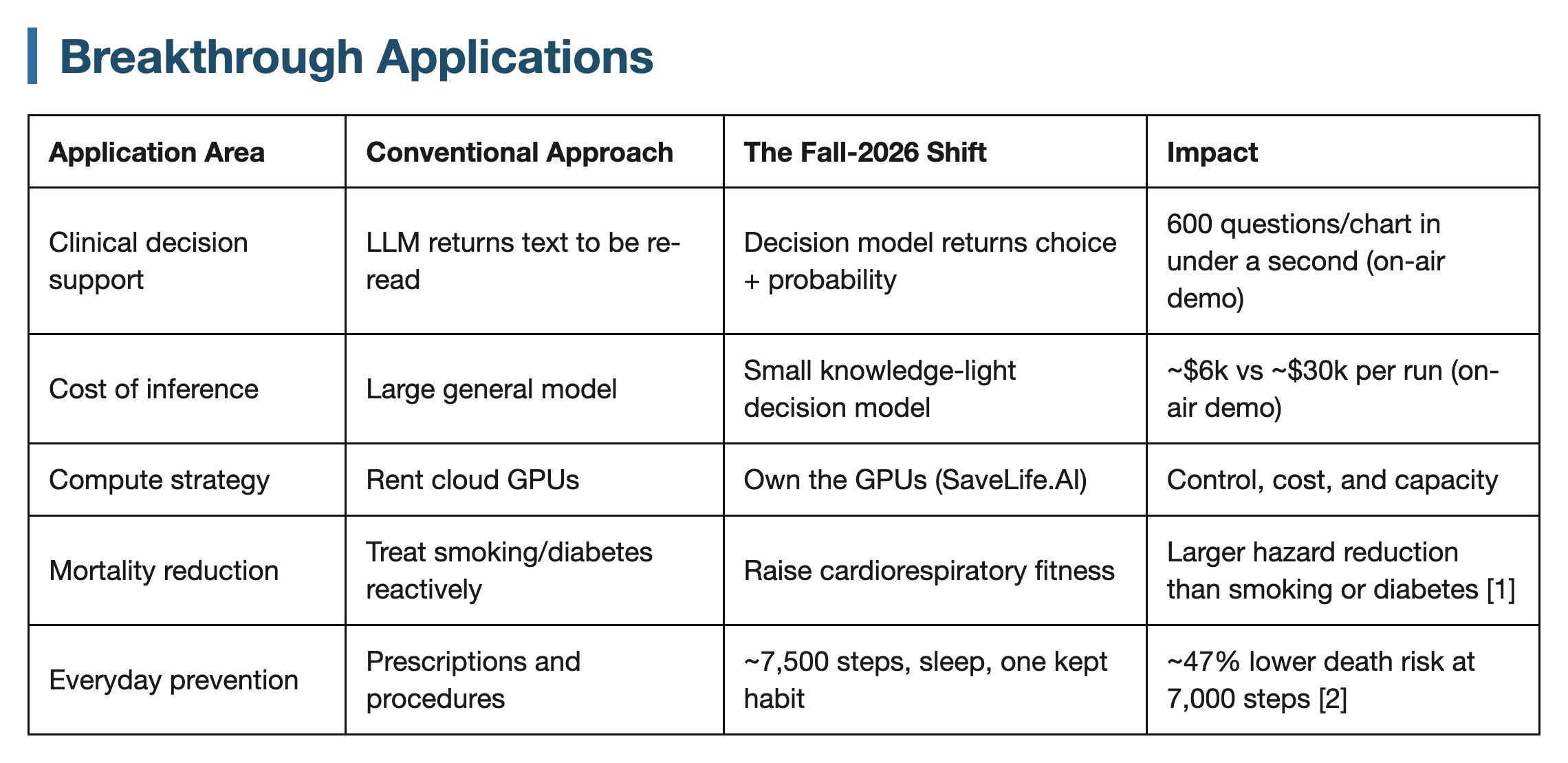
4. Breakthrough Applications
5. Implementation Challenges
Trust in calibrated outputs. A decision-plus-probability is only useful if the probability is well calibrated and auditable; a confident wrong decision at machine speed is dangerous at machine scale.
The AGI narrative. Junaid is skeptical of the “scare,” arguing self-evolving research agents and “benchmark-as-teacher” are evolutionary, not apocalyptic. Separating signal from hype is its own challenge.
Behavior change is the hard part. The prevention evidence is strong [1][2], but getting people (and especially, as Junaid notes, men) to act on it remains the bottleneck.
Verification of claims. Specific model and vendor names from the episode need confirmation, a reminder that fast-moving AI claims should be checked before they are repeated.
Access and equity. Owning GPUs and advanced decision models concentrates capability; prevention tools must reach the people who benefit most.
6. Industry Crisis Solution
The crisis underneath both shifts is misdirected effort. Healthcare AI has spent enormous resources making models that talk well, and healthcare itself spends most of its resources reacting to emergencies that began silently years earlier. Harvey’s father is the human version of that failure, an emergency with no prior symptoms.
The solution the episode frames is to align the technical and the clinical. Build AI that returns fast, cheap, calibrated decisions, and point those decisions at prevention: fitness, movement, sleep, and early detection. Run the EHR as a decision machine not to generate more notes but to surface the micro-decisions that keep a patient out of the emergency department. Keep the probability honest and a human accountable. And on the human side, make the no-prescription basics, cardiorespiratory fitness and daily steps, a first-line intervention, because the data say they outperform much of what we treat reactively [1][2]. Decision-first AI plus prevention-first medicine is the combination that bends the curve.
7. Stakeholder Recommendations
Health-system and clinical-AI leaders: Pilot decision-model backends for high-volume, well-scoped questions (medication reconciliation, chart triage), and demand calibration and audit, not eloquence.
Clinicians: Treat cardiorespiratory fitness as a vital sign and prescribe movement first; the mortality math favors it [1][2].
Investors and builders: The value is migrating from the largest chat model to the leanest, cheapest decision engine and the compute to run it.
Payers and policymakers: Reimburse prevention (fitness, steps, early detection) as the high-ROI intervention it is, and fund the decision-support infrastructure that targets it.
Individuals: Pick one habit, around 7,500 steps, sleep, or a workout, and keep it; the best emergency is the one that never comes.
8. Future Vision
The future this episode sketches is not a bigger chatbot. It is a quiet, fast decision layer sitting behind every clinical workflow, returning calibrated choices in milliseconds and costing pennies, pointed squarely at keeping people well. On the human side, it is a culture that treats fitness and movement as medicine because the evidence demands it [1][2], and that measures success not by emergencies handled but by emergencies prevented. Junaid’s machines-not-humans shift and Harvey’s reactive-to-proactive shift are the same idea told from two ends: make the intelligence cheap and the goal right. If the industry gets both, the measure of healthcare AI in a few years will not be how fluently it writes, but how many emergencies never had to start.
References
[1] Mandsager K et al., JAMA Network Open (2018), Cleveland Clinic: Association of Cardiorespiratory Fitness With Long-Term Mortality (122,007 adults; least-fit vs elite-fit all-cause mortality HR ~5.04; low fitness risk greater than smoking (HR 1.41) or diabetes (HR 1.40); no plateau): https://jamanetwork.com/journals/jamanetworkopen/fullarticle/2707428
[2] Paluch AE et al., The Lancet Public Health (2022): Daily steps and all-cause mortality, meta-analysis of 15 cohorts (47,471 adults; ~7,000 steps/day associated with ~47% lower mortality vs ~2,000; benefit plateaus ~7,000-9,000): https://www.thelancet.com/journals/lanpub/article/PIIS2468-2667(21)00302-9/fulltext
[3] Kahneman D, Thinking, Fast and Slow (System 1 / System 2) and the reinforcement-learning-from-human-feedback literature provide the conceptual frame for the “decision vs language” shift discussed on-air. Specific model and company names from the episode are pending spelling/identity verification.
One challenge with healthcare AI is making sure it fits into the clinician's existing workflow. A tool can be technically impressive, but if it adds extra steps or requires too much correction, adoption becomes difficult. The real value is in making everyday clinical work easier.