
The One-Mile Gap: Why Breakthrough Medical AI Never Reaches the Patient
An Oxford Scientist on Imaging AI, Proactive Medicine, and the Translation Problem Healthcare Can’t Ignore

Executive Summary
Medical AI is not short on capability — it is short on translation. Algorithms are clearing regulators at record pace, imaging AI is the fastest-moving category in the field, and the underlying science can now infer a contrast-enhanced cardiac MRI without any contrast at all. Yet the version that dazzles in an Oxford lab routinely fails to reach a community hospital one mile down the road. In this episode of Signal & Symptoms, Dr. Harvey Castro hosts — with co-hosts Ed Marx and Dr. Isha Mannering — a conversation with Dr. Yeshe Kway, a medical data scientist in Oxford’s Zhang Group who builds the AI that reads cardiovascular MRI.
The discussion reframes the healthcare-AI debate around a single question: can medicine keep up with AI? Not the models — the system. This briefing breaks down the market accelerating past the point of adoption, the reimbursement machinery that strands proven tools, the shift from reactive to proactive medicine that imaging AI makes possible, and the ethical fault lines — from predicting disease in children to an employer misusing a predictive scan — that open the moment prediction outruns policy.
1. Market Landscape
The capability curve is steep. The global AI-in-medical-imaging market is projected to grow from roughly $1.70B in 2024 to $16.88B by 2034 (≈25.8% CAGR) [1]. Regulators are keeping pace: more than 1,160 radiology AI algorithms have received FDA marketing authorization — about 76% of all FDA-authorized AI — with clearances now running near 30 per month [2][3].
The pressure behind that curve is the knowledge problem. A widely cited 2011 projection estimated the doubling time of medical knowledge would fall to roughly 73 days by 2020 — down from an estimated 50 years in 1950 (a projection, not a measurement, and best cited with that caveat) [4]. No clinician can absorb that manually; AI becomes less a luxury than a coping mechanism.
And the stakes are cardiovascular. CVD is the leading cause of death worldwide, responsible for roughly 19.2 million deaths in 2023 — about one in three deaths globally — with a third occurring prematurely in people under 70 [5][6]. Much of it is detectable, and preventable, earlier than it is caught today.
2. Major Player Analysis
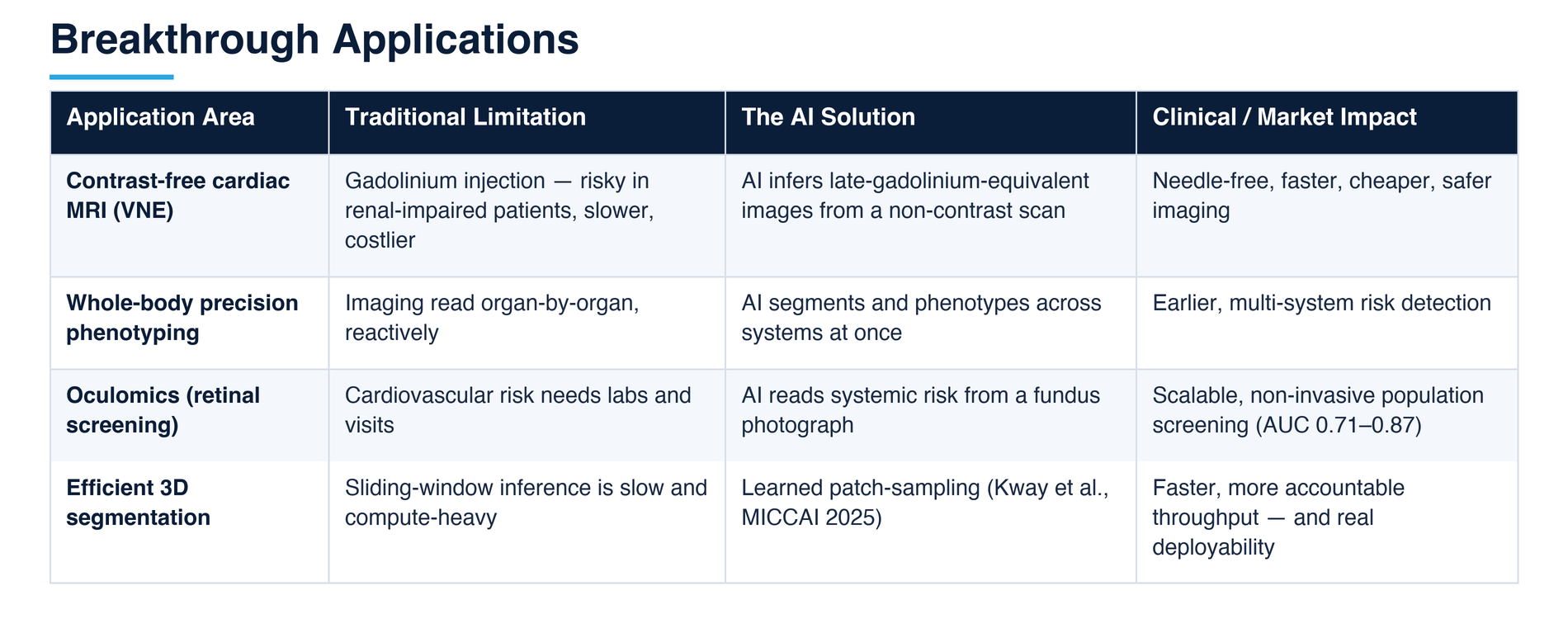
Academic translational labs. Oxford’s Zhang Group (where Dr. Kway works) is behind Virtual Native Enhancement (VNE) — deep-learning that produces late-gadolinium-equivalent cardiac images from a contrast-free scan [10][11]. This is the archetype of the translation gap: proven, published, and still not at most bedsides.
Big-tech research. Google Health and others pioneered oculomics — predicting cardiovascular risk factors directly from a retinal photograph [7].
The imaging-AI vendors. Radiology dominates authorized AI, but reimbursement lags the clearances badly [12].
The payers. CMS and commercial payers are the real gatekeepers — the point where a cleared, effective model either gets used or doesn’t.
3. ROI & Business Case
Hard ROI (contrast-free imaging). VNE removes the gadolinium injection — relevant because kidney disease is present in roughly 20% of myocardial-infarction patients — while shortening scan time and cost and eliminating the needle [10][11].
Hard ROI (scalable screening). Oculomics turns a routine retinal photo into a non-invasive cardiovascular screen, with reported model AUCs of 0.71–0.87 [7] — population screening without a blood draw or a specialist visit.
Soft ROI (proactive care). Shifting detection upstream attacks a disease that kills ~19.2M a year, a third of them prematurely [5]. Prevention is where the dollars — and lives — compound.
The cost of inaction. Most imaging-AI tools carry temporary Category III CPT codes that are not tied to payment, and there is no clear Medicare benefit category [8][9]. Capability without a payment path equals shelved capability.
4. Breakthrough Applications
5. Implementation Challenges
The reimbursement wall. Category III CPT codes don’t pay, and there’s no dedicated Medicare benefit category for AI interpretation [8][9] — the single biggest reason cleared tools sit unused.
Fee-for-service misalignment. A system that bills per procedure struggles to value a tool whose payoff is prevention spread across time.
Workflow and population shift. A model that excels on one population and scanner often degrades in a different hospital’s real workflow.
Accountability. Deployment demands accountable AI — auditable, explainable, monitored — not just accurate AI.
The ethics of prediction. Once a scan can forecast disease, hard questions follow: do you tell a healthy child? Could an employer or insurer misuse the result?
6. Industry Crisis Solution
The crisis isn’t that the technology doesn’t work — it’s that proven technology stops one mile short of the patient, while cardiovascular disease keeps killing ~19.2 million people a year, much of it detectable earlier. The bottleneck is a trio: payment, workflow, and trust.
The solution is to fix the pathway, not just the model. Align payment with value — the December 2025 CMS ACCESS model testing outcome-aligned payments, and the April 2025 addition of separately billable HCPCS SaaS codes, are early steps in the right direction [9]. Build AI that is accountable and auditable so health systems can defend deploying it. And keep the clinician in the loop as the point of judgment and trust. Deployed this way, AI moves medicine from reactive to proactive where the evidence already supports it — and the one-mile gap finally closes.
7. Stakeholder Recommendations
Executives / health systems: Budget for the deployment — reimbursement strategy, workflow integration, monitoring — not just the model license. Prioritize tools with an accountability story you can defend to a board and a regulator.
Investors: The durable value increasingly sits in translation and deployment infrastructure — and in navigating reimbursement — as much as in model IP.
Policymakers: Close the CPT / Medicare-benefit-category gap (ACCESS and HCPCS SaaS codes are a start [9]) and get ahead of predictive-AI misuse — employer and insurer discrimination on AI-derived risk needs guardrails before it becomes routine.
Clinicians: Use AI to move upstream into prevention, demand accountability from the tools you adopt, and keep human judgment at the center of the call.
8. Future Vision
The near future of medicine looks less like a dramatic new cure and more like a quiet shift in when care happens. A routine scan — or even a retinal photo — flags cardiovascular risk years before the event, contrast-free and needle-free, read by a model that is fast, auditable, and paid for by the outcomes it improves. The technology to do this largely exists today. Whether it reaches the patient depends not on the next breakthrough, but on whether healthcare finally closes the one-mile gap between what works and what’s within reach. That’s what it will take for medicine to keep up with AI.
References
[1] AI in Medical Imaging Market (size & CAGR) — https://media.market.us/global-ai-in-medical-imaging-market-news/
[2] Radiology Business — Radiology gets new FDA-cleared algorithms — https://radiologybusiness.com/topics/artificial-intelligence/radiology-gets-68-new-fda-cleared-algorithms
[3] The Imaging Wire — FDA numbers show radiology maintaining its lead — https://theimagingwire.com/2026/03/11/numbers-from-the-fda-show-radiology-is-maintaining-its-lead/
[4] Densen P. — Challenges and Opportunities Facing Medical Education (medical-knowledge doubling projection, 2011) — https://www.researchgate.net/publication/51231641_Challenges_and_Opportunities_Facing_Medical_Education
[5] American College of Cardiology — Cardiovascular Diseases Caused 1 in 3 Global Deaths in 2023 — https://www.acc.org/About-ACC/Press-Releases/2025/09/23/19/19/Report-Cardiovascular-Diseases-Caused-1-in-3-Global-Deaths-in-2023
[6] World Health Organization — Cardiovascular diseases — https://www.who.int/health-topics/cardiovascular-diseases
[7] MDPI Biomedicines — Retinal Imaging-Based Oculomics: AI in Diagnosis of Cardiovascular and Metabolic Diseases — https://www.mdpi.com/2227-9059/12/9/2150
[8] NEJM AI — Scaling Adoption of Medical AI — Reimbursement from Value-Based Care and Fee-for-Service Perspectives — https://ai.nejm.org/doi/full/10.1056/AIpc2400083
[9] Bipartisan Policy Center — Paying for AI in U.S. Health Care — https://bipartisanpolicy.org/issue-brief/paying-for-ai-in-u-s-health-care/
[10] Circulation — AI for Contrast-Free MRI: Virtual Native Enhancement — https://www.ahajournals.org/doi/10.1161/CIRCULATIONAHA.122.060137
[11] NIHR Oxford BRC — AI replaces contrast dye for fast, cheaper, needle-free cardiac MRI — https://oxfordbrc.nihr.ac.uk/ai-replaces-contrast-dye-for-fast-cheaper-and-needle-free-cardiac-mri-scans/
[12] Radiology Business — Radiology dominates FDA-cleared AI, but reimbursement lags far behind — https://radiologybusiness.com/topics/artificial-intelligence/radiology-dominates-fda-cleared-ai-reimbursement-lags-far-behind