

Executive Summary
Health systems are not short on AI pilots; they are short on pilots that survive a board meeting. Roughly 80% of healthcare AI projects fail to scale beyond the pilot phase, often because a model that hits 95% accuracy on a curated lab dataset falls toward 70% on fragmented real-world patient data [1]. On this episode of Signal & Symptoms, Dr. Alan Young, a physician executive now with the clinical data intelligence platform Evidently who has also sat in the vendor, consulting, operator, and buyer seats, joins host Dr. Junaid Kalia with co-hosts DR GPT™ Harvey Castro and Dr. Isha Mannering to explain what actually goes wrong when health systems buy AI.
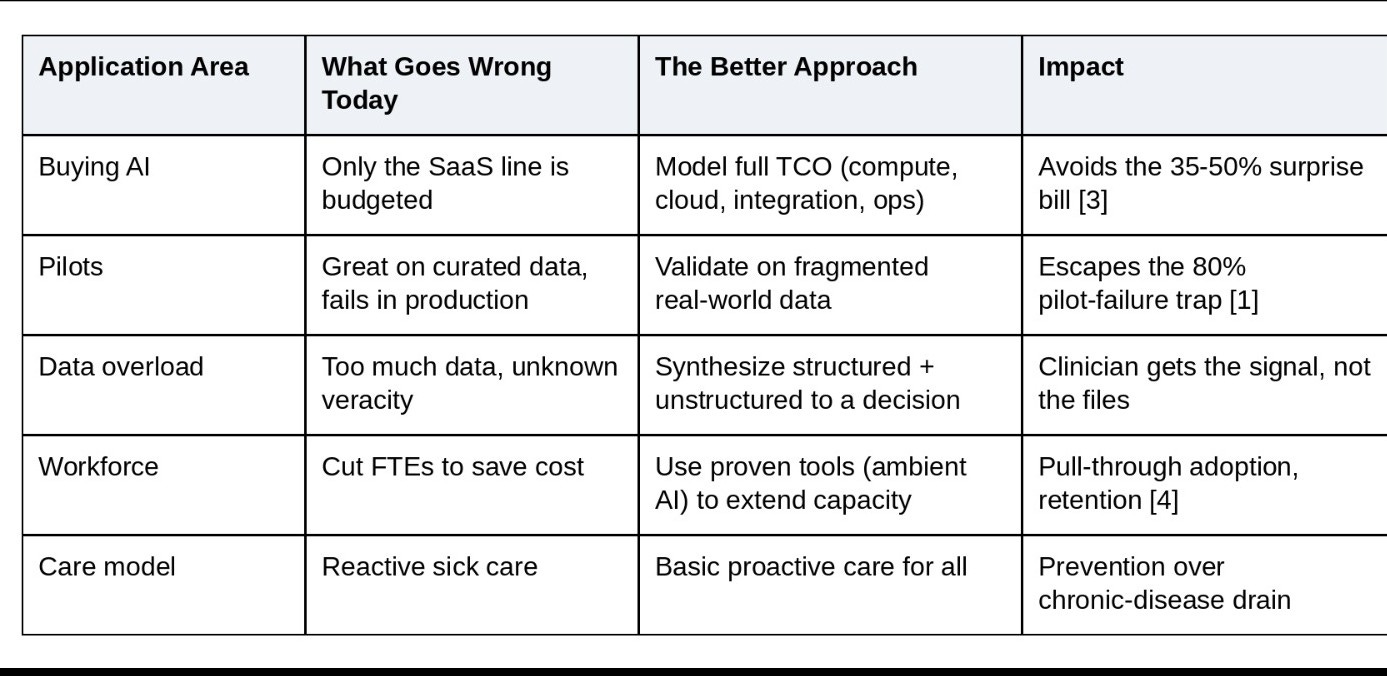
Three failures recur. First, the hidden cost: compute, cloud, data centers, integration, and operations routinely dwarf the visible SaaS subscription, and hidden costs add an estimated 35% to 50% to the original budget [3]. Second, misaligned incentives: buy decisions made on financials lead to headcount cuts that quietly erode care capacity. Third, data veracity: a large dataset is worth little if a fifth of it is wrong. The path out, as 2026 turns into healthcare’s “show me the money” year [2], is to budget the whole iceberg, interrogate the data, and align incentives before signing.
1. Market Landscape
2024 was experimentation, 2025 was pilots, and 2026 is the year ROI becomes the forcing function [2]. The problem is the leap from pilot to production: about 80% of healthcare AI projects never scale past the pilot, and the core reason is not the algorithm but the gap between curated demo data and messy production data (diagnostic tools that score 95% on lab datasets can drop toward 70% on real patients) [1]. Dr. Young’s blunt framing on-air: some vendors and some systems will simply be consolidated or go out of business, and no one yet measures success accurately.
Where ROI does land, it lands fast: recent scorecards put healthcare AI returns at roughly 3.5x, often within about 12 months, exceeding expectations in around 40% of use cases [2]. The winners are not the flashiest pilots; they are the deployments that can be governed, audited, and defended at scale.
2. Major Player Analysis
Clinical data intelligence platforms. Evidently is the archetype Dr. Young describes: AI that reads structured and unstructured EHR data and synthesizes what a clinician actually needs, so the value is in the decision surfaced, not the data volume stored.
EHR incumbents. They created the “too much data” problem, embedded across most major systems, that the intelligence layer now has to tame.
Ambient AI vendors. The proven on-ramp. Ambient documentation has driven real adoption (associated with large burnout reductions in health-system studies [4]), creating the clinician “pull-through” effect Dr. Young notes, where staff expect, and choose employers for, these tools.
The buyers. Health-system executives, whose incentives (financial projections, FTE costs) shape what gets bought, deployed, and cut.
Compute owners. As Junaid notes with SaveLife.AI™ bringing its own GPUs online, controlling compute is how some builders push delivery cost toward zero, while buyers who rent it absorb the hidden bill.
3. ROI & Business Case
Budget the whole iceberg. The SaaS line is the small number. Data preparation can run 20% to 60% of a project budget, EHR integration $20K to $100K+, compliance $20K to $200K per year, and workforce training $300K to $600K at large hospitals, with hidden cloud and compute costs reaching 60% to 80% of AI cloud spend and TCO landing 35% to 50% above the original budget [3].
Hard ROI and soft ROI. Beyond dollar savings, Junaid’s “soft ROI” is real: spending to retain one near-irreplaceable specialist (a search that can cost close to a million) can justify a multi-million investment.
Data veracity gates all of it. A trillion data points are worth little if 20% are inaccurate, incomplete, or hallucinated; the ROI is in synthesis and truthfulness, not volume.
ROI is attainable when scoped right. 3.5x within a year is on the table for deployments that reach production and can be measured [2].
4. Breakthrough Applications
5. Implementation Challenges
The surprise bill. Compute, cloud, and data-center costs sit above the SaaS subscription and are routinely missed in the fine print, which deters the next investment [3].
Misaligned incentives. Executives buy and cut on financials; reducing headcount to control FTE cost lowers surgical, procedural, and visit capacity and degrades the patient experience, the opposite of the intended return.
Stewardship gap. The money flows through healthcare, but, as Dr. Young puts it, it is not always captured by the best stewards, so reinvestment lags.
Data veracity. Production data is fragmented and partly wrong; without a truthfulness layer, more data just means more risk [1].
Measuring success. No shared, accurate measure of AI success yet exists, which is why so many pilots cannot defend themselves to a board [1][2].
6. Industry Crisis Solution
The crisis is a buying crisis dressed up as a technology crisis. Systems sign for the visible subscription, discover the invisible costs, cut staff to cover them, and then cannot show the board a defensible return, so the next project dies in pilot purgatory. Dr. Young’s insider view is that this is fixable, because the mistakes are procurement mistakes, not algorithm mistakes.
The solution the episode frames: model the full total cost of ownership before signing, not just the SaaS line [3]; insist on validation against fragmented real-world data, not curated demos [1]; put a data-veracity layer between the EHR and the model so clinicians get synthesized truth, not raw volume; align incentives so AI extends clinician capacity rather than becoming an excuse to cut it; and measure ROI, hard and soft, in terms the board can defend [2]. Do that, and the proven on-ramps (ambient AI and the clinician pull-through they create [4]) carry the rest.
7. Stakeholder Recommendations
Health-system executives and boards: Demand a full TCO model (compute, cloud, integration, ops) and a production-data validation plan before signing [1][3]. Treat headcount cuts as a care-capacity decision, not just a cost one.
CMIOs and clinical leaders: Prioritize a data-veracity and synthesis layer so AI surfaces decisions, not files; start with proven ambient tools that clinicians already pull for [4].
Vendors: Price the whole iceberg honestly and validate on real-world data; the market is moving to “show me the money” [2].
Investors: Back the intelligence and veracity layer and deployments that can scale past pilot, not the demo that shines only on curated data [1].
Patients: The payoff to demand is continuity, your history known, your care proactive, not repeated from scratch at every visit.
8. Future Vision
The future Dr. Young argues for is a health-care system rather than a sick-care one: AI that delivers a basic level of proactive care to everyone, catching and preventing the chronic conditions that drain the system before they become emergencies. Getting there is less about a smarter model than about smarter buying, honest costs, truthful data, aligned incentives, and measured return. As the cost of delivering AI trends toward zero and clinician expectations rise to meet consumer-grade convenience, the systems that win will be the ones that budgeted the whole iceberg, trusted only the data worth trusting, and spent the savings on care instead of capturing them on the way out. The hype fades, the pilots end, and what remains is the only question that matters: did it make care better, and can you prove it.
References
[1] HealthTech Digital / HIT Consultant (2026): The AI implementation gap, roughly 80% of healthcare AI projects fail to scale beyond pilot; diagnostic AI ~95% accuracy on lab datasets dropping toward 70% on real patient data: https://healthtechdigital.com/the-ai-implementation-gap-why-80-of-healthcare-ai-projects-fail-to-scale-beyond-pilot-phase/
[2] Bessemer Venture Partners, The 2026 Healthcare AI ROI Scorecard (ROI ~3.5x, typically within ~12 months, exceeding expectations in ~40% of use cases; 2026 as the “show me the money” year): https://www.bvp.com/atlas/the-2026-healthcare-ai-roi-scorecard
[3] TechTarget / CloudOptimo / industry TCO guides (2026): hidden AI costs, data preparation 20-60% of budget, EHR integration $20K-$100K+, compliance $20K-$200K/year, training $300K-$600K at large hospitals, hidden cloud/compute 60-80% of AI cloud spend, TCO 35-50% above the original budget: https://www.techtarget.com/healthtechanalytics/feature/The-cost-of-AI-in-healthcare-explained-Is-It-worth-it
[4] Ambient AI scribe evidence (2026): large associated reductions in physician burnout and rapid adoption driving a clinician “pull-through” effect: https://www.advisory.com/daily-briefing/2026/02/04/ambient-ai-oi-ec